2026 LIFO Election Opportunities Guide

2026 LIFO Election Opportunities Guide

Find the industries with the most meaningful 2026 LIFO tax savings opportunities. Quickly estimate election year LIFO tax benefits. Learn about LIFOPro’s complimentary resources and offerings designed to simplify LIFO election scoping.

Download LIFOPro's 2026 LIFO Election Opportunities Guide
Download LIFOPro's 2026 LIFO Election Candidates List & Tax Benefits Calculator Tool

Section 1: 2026 LIFO Election Opportunities

  • 2026 Top Five LIFO Election Locks

    The most ideal time to elect LIFO is when inflation is greater than or equal to the historical averages, and the biggest tax savings opportunities occur when the adoption year inflation is significantly higher than normal. This is because the election year LIFO tax benefit is primarily dependent on how much inflation occurred in the year of adoption. Since LIFO must be applied prospectively for tax purposes & can not be retrospectively, it’s imperative for companies who’ve experienced elevated or record high inflation this year to begin scoping out a 2026 LIFO election now (current year LIFO tax benefits are use it or lose it).

    2026 inflation has been significantly higher than historical averages in the majority of industries. The Bureau of Labor Statistics Producer Price Index (BLS PPI) All commodities 2026 year to date inflation rate of 13.4% is nearly 6 times higher than its 2.4% historical average annual inflation rate. Because of this, there are numerous tax savings opportunities for companies who adopt LIFO this year. 11 of the 14 BLS PPI major groupings have 2026 year to date inflation that’re higher than historical averages. The five best 2026 Top LIFO Election locks are listed below by BLS PPI major grouping and their respective subgroups. Included in the list are the following figures:

    • Current year inflation rate: Used to calculate the current year LIFO tax benefit by taking the product of the current year inflation rate and the prior year end inventory balance
    • Current year tax benefit multiplier (TBM): Measures the current vs. historical average annual inflation rate. For example, a 10% current year inflation rate and 2% historical average annual inflation rate creates a current year tax benefit multiplier of 5x since the 10% inflation rate and LIFO tax benefit will be 5 times larger than historical norms.
    1. Fuel and related products: 43% inflation & 11x TBM
      • Crude petroleum: 59% inflation & 11x TBM
      • Refined petroleum products (including gasoline): 112% inflation & 25x TBM
      • Asphalt and other petroleum and coal products: 43% inflation & 6x TBM
    2. Metals and metal products: 12% inflation & 3x TBM
      • Steel mill products (sheet/strip/coil, bars/plates/angles/shapes & pipe/tube): 28% inflation & 8x TBM
      • Nonferrous mill shapes (including copper and aluminum): 15% inflation & 4x TBM
      • Nonferrous wire and cable: 16% inflation & 4x TBM
      • Fabricated metal products: 7% inflation & 2x TBM
    3. Chemicals and allied products (including plastic resins): 9% inflation % 3x TBM
      • Industrial chemicals: 18% inflation & 9x TBM
      • Plastic resins and materials: 13% inflation & 14x TBM
      • Polish and other sanitation goods (including soaps & cleaners/detergents): 5% inflation & 2x TBM
    4. Machinery & equipment: 8% inflation & 3x TBM
      • Electronic computers and computer equipment: 22% inflation & 6x TBM
      • Electrical machinery & equipment: 14% inflation & 10x TBM
      • Electrical instruments: 8% inflation & 3x TBM
    5. Rubber and plastic products: 6% inflation & 2x TBM
      • Rubber and rubber products: 5% inflation & 2x TBM
      • Plastic products: 6% inflation & 2x TBM

    Items of note on the above list are as follows:

    • The above list is applicable for all stages of supply chain, meaning manufacturers, wholesalers/distributors and retailers are all eligible to utilize the inflation rates listed above to their LIFO calculation upon election
    • The inflation rates listed above are a reasonable means to calculate a high-level estimate of the 2026 LIFO tax benefit because they are the same values used to make actual LIFO calculations (use of external inflation indexes is aka the IPIC method, which many companies use)
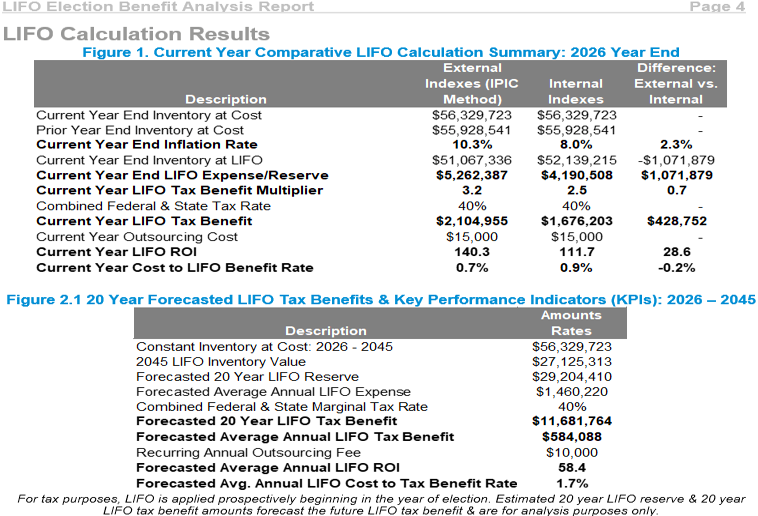
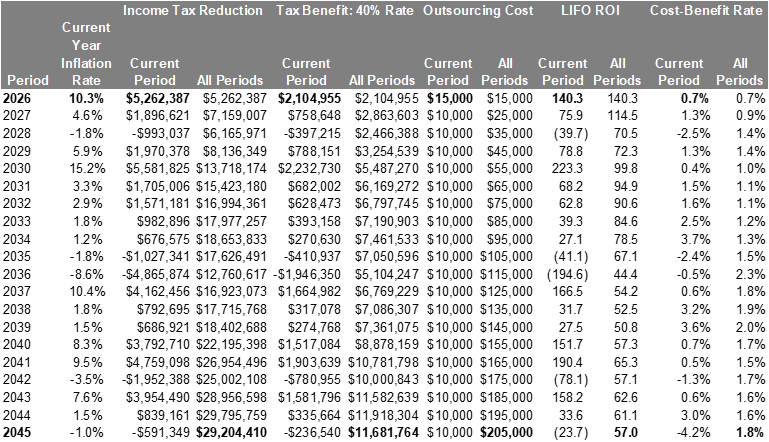
    • A high-level 2026 LIFO tax benefit can be performed by multiplying the 2026 year to date inflation shown above by the prior year end’s inventory balance gross of reserves (12/31/2025 for December year end companies). See the Quick LIFO tax benefit example shown in Section 2 below for a detailed illustration.

    Download LIFOPro’s 2026 Top LIFO Election Candidates List & Tax Benefit Calculator by clicking this link:

    LIFOPro’s 2026 Top LIFO Election Candidates List & Tax Benefit Calculator

  • 2026 Top LIFO Election Candidates List Overview

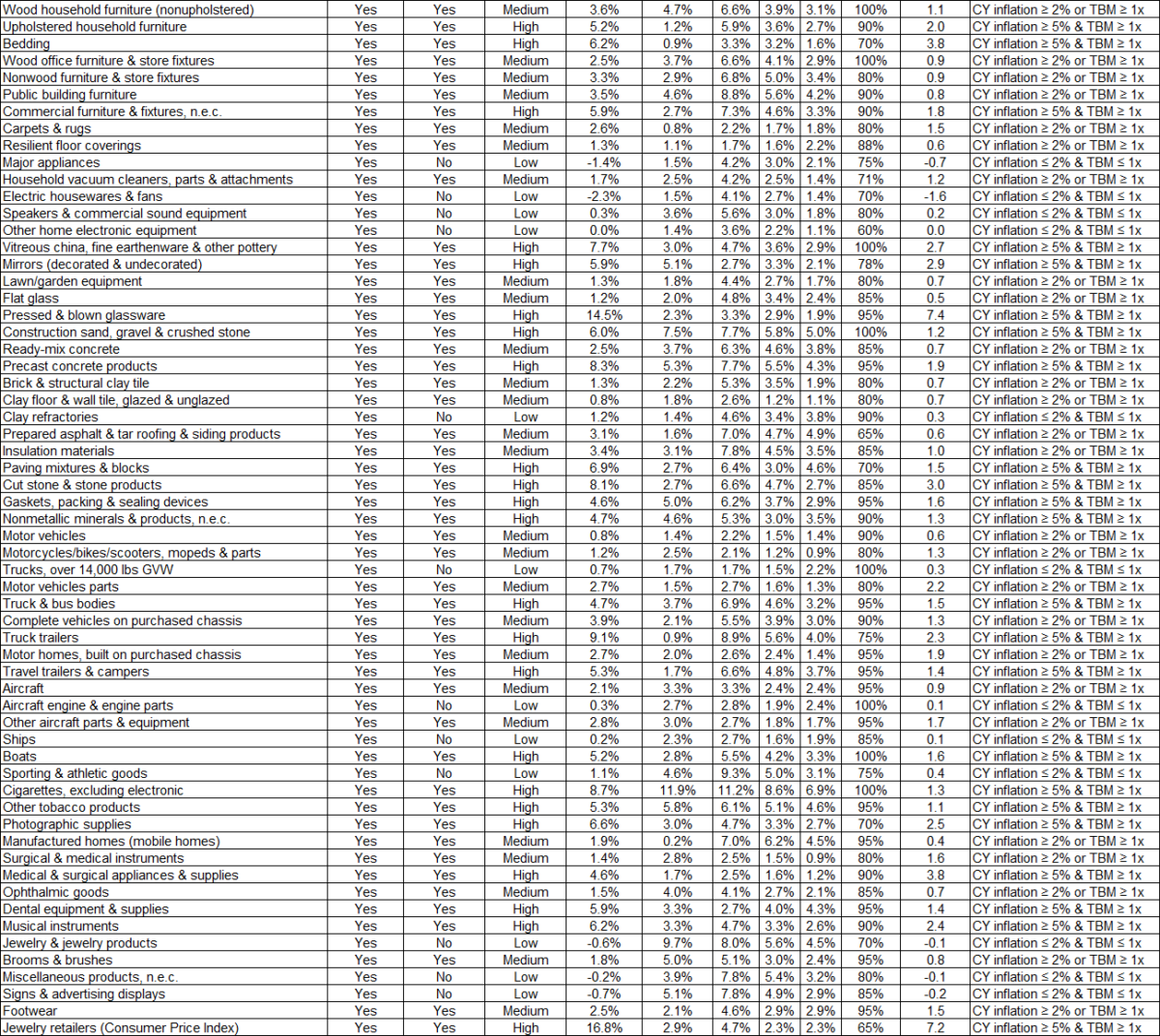
    LIFOPro’s Top LIFO Election Candidates list is published annually to enable LIFO election scoping to be seamlessly integrated into year end tax planning. To minimize the time and effort required by CPA firms and companies to complete the LIFO election scoping process, we utilize proprietary KPIs and government inflation data to provide objective assessments on the preferability of LIFO and the timing of the election, and to estimate current and future LIFO tax benefits (KPI criteria listed on Page 3). CPA firms and companies can quickly accomplish the following using LIFOPro’s 2026 Top LIFO Election Candidates List:

    • Pre-screening companies/industries that should perform 2026 LIFO election scoping (benefit analysis)
      • Determine if LIFO is preferable for companies/industries
      • Determine if companies/industries are 2026 top LIFO election candidates
    • High-level 2026 LIFO election scoping for companies or industries
      • Estimate 2026 tax benefit from electing LIFO
      • Forecast expected future tax benefits of using LIFO
      • Forecast the expected future probability of LIFO annually creating a tax benefit
    • Record preliminary 2026 year end LIFO adjusting journal entry prior to completing final year end LIFO calculation (if there’s a high likelihood that LIFO will be elected this year; can be done to ensure LIFO is integrated into year end financial statements, which IRS LIFO conformity rule requires)

    Our list is built upon the Bureau of Labor Statistics Producer Price Index (BLS PPI) groupings. They are an accurate and credible source for quickly measuring LIFO’s preferability, election timing and estimated tax benefits because many companies use these same indexes to perform the required LIFO inflation calculations, and the use of BLS PPIs for LIFO purposes is widely accepted by the IRS. It is organized into the following four tables:

    • Table 1.1 – Dealerships: Includes automobile, powersports, ag/farm and construction equipment/machinery
    • Table 1.1 – Major commodity group: BLS PPI major commodity groups are the least-granular or broadest BLS groupings, and there are a total of 15 major commodity groups
    • Table 2 – Subgroups: There are a total of 96 subgroups which break out goods into more granular groupings than the 15 major commodity groups
    • Table 3 – Product classes: There are a total of 301 product classes which break out goods into more granular groupings than the 15 major commodity groups and 96 subgroups

    Our list includes the following content for each Bureau of Labor Statistics Producer Price Index (BLS PPI) group:

    • Pre-screening fields
      • LIFO is preferable: Measures preferability & if election scoping should occur
        • Yes: LIFO is preferable & election scoping should be performed at some point in time
        • No: LIFO is not preferable, should not be used & scoping shouldn’t be performed
      • 2026 Top LIFO Election Candidate: Measures election scoping timing (when it should occur)
        • Yes value indicates LIFO election scoping should be performed this year
        • No value indicates LIFO election scoping should be deferred to a future period
      • 2026 LIFO Election Priority: Ranking system based on the following:
        • High: Best opportunity; 2026 inflation rate is ≥ 5% and/or 2026 tax benefit multiplier is ≥ 2x
        • Medium: Good opportunity; 2026 inflation rate is ≥ 2% and/or 2026 tax benefit multiplier is ≥ 1x
        • Low: LIFO election should be deferred to a future period when inflation & tax benefits are higher
        • N/A: Not applicable because LIFO is not preferable & therefore should not be used 
    • Election scoping fields
      • 2026 inflation rate: Used to estimate 2026 LIFO expense/reserve
      • Historical average annual inflation rate: Used to forecast future LIFO tax benefits & rank the priority of a current year LIFO election by comparing current & historical inflation rates
      • 20 year inflation frequency rate: Measures the risk of future LIFO recapture where highest inflation frequency rates represent the lowest chance of future recapture and the lowest rates carry higher risk
  • LIFOPro’s Preferability & Top LIFO Election Candidate Scoring System & Criteria

    LIFOPro uses proprietary inflation metrics and a standard grading system to establish whether or not LIFO is a preferable method for a company or given industry. From this grading system, a determination can be made regarding if a company is a LIFO preferability, and subsequent recommendations are also provided regarding the proper timing of when to elect LIFO. Our grading system & scoring criteria is organized as follows:

    • LIFO preferability criteria: These criteria use past pricing metrics sourced from the Bureau of Labor Statistics Consumer/Producer Price Indexes (BLS CPI/PPI) to establish preferability as of the time of exploring a LIFO election, which are as follows:
      • Inflation level – How much inflation has there been historically?
        • The inflation level is the most fundamental metric used to establish LIFO as a preferable method because higher the historical inflation level, the higher the likelihood that LIFO will create a material tax benefit and be more clearly reflective of income than other non-LIFO methods
        • LIFOPro’s inflation level requirement is to have a long-term average annual inflation rate of 1% or more. Auto dealers and supermarkets (predominant users of LIFO) have 20 year average annual inflation rates of around 1% – 2%, which is more than sufficient to establish preferability because over a 20 year period, there will have been 20% – 40% cumulative inflation, and in most cases, inflation at this level will yield material long-term LIFO tax benefits.
      • Inflation frequency – How often has inflation occurred historically?
        • Inflation frequency is another key metric used to establish LIFO as a preferable method because the more often there has been inflation in the past, the higher the likelihood that LIFO will be most clearly reflective of income & create a tax benefit in the future
        • Inflation frequency is also an important LIFO risk assessment metric because there is an inverse relationship between the amount of LIFO risk and inflation frequency rate. More specifically, the lower the inflation frequency rate, the higher amount of LIFO risk. Conversely, the higher inflation frequency rate, the lower the risk. Certain industries have 20 year inflation frequency rates of 100% (inflation measured in all of the last 20 years), meaning there is little or no LIFO risk in these areas.
      • Both of the aforementioned criteria must be met for LIFO to be a preferable method and for a company/industry to be a LIFO preferability. LIFO is not a preferable method and a company/industry is not a LIFO preferability if neither or only one of the two historical preferability criteria is met.
    • LIFO election timing criteria: Provide the basis of the recommended LIFO election timing, which are as follows:
      • Both of the LIFO preferability criteria are met
      • Current year vs. 20 year average inflation rate multiplier (2026 Election Inflation Multiplier) of ≥ 1 – This criteria exists to ensure the election year inflation rate is as much or more than the historical average
        • 2026 Election Inflation multiplier is calculated by taking the quotient of the Current year inflation rate and the 20 year average annual inflation rate
        • Current year inflation rate uses 12M ended December 2026 BLS PPI
        • The 20 year average annual inflation rate computed using the BLS PPI 20 year average annual inflation rate as of December 2026 (if available; 3/5/10 year average annual inflation rates used for BLS PPIs that have existed for less than 20 years)
      • LIFOPro’s 2026 Election Inflation Multiplier criteria is to have a multiplier of greater than or equal to 1. For example, if there’s 5% inflation in 2026 & a 20 year average annual inflation rate of 2%, the inflation multiplier would be 2.5 & a current year LIFO election would be recommended since the multiplier is greater than 1.
      • A company/industry must meet all LIFO preferability (preferability) criteria & have a 2026 Election Inflation Multiplier of 1 or greater for a 2026 LIFO election to be recommended. If a company/industry is a LIFO preferability but has a 2026 Election Inflation Multiplier of less than 1, LIFOPro recommends deferring a LIFO election until a later period
      • Note: Certain BLS PPIs will be 2026 Top LIFO candidates despite having Election Year Inflation Multipliers of < 1 because they have a current year inflation rate of ≥ 2% & an inflation frequency rate of ≥ 50%, which satisfies LIFOPro’s preferability criteria

    LIFOPro’s grading system & scoring criteria are integrated into LIFOPro’s 2026 Top LIFO Election Candidates Tables shown below. They’re also integrated in our complimentary LIFO election benefit analysis reports prepared for companies who aren’t on LIFO but are considering adoption. Provided below are LIFOPro’s 2026 Top LIFO Candidates List separated into four tables.

  • LIFOPro’s Top LIFO Election Candidates Tables

    Table 1.1 Dealership 2026 Top LIFO Candidates
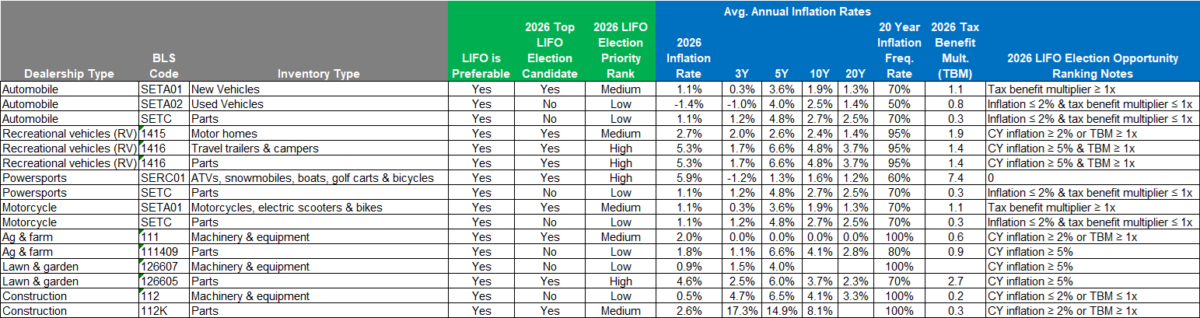
    Table 1.2 2026 Top LIFO Candidates by BLS PPI Major Commodity Group
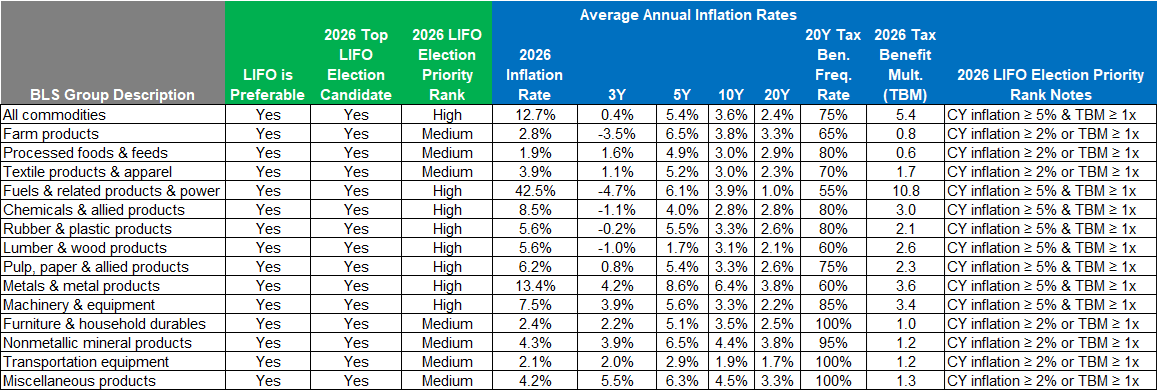
    Table 2. 2026 Top LIFO Candidates by BLS PPI Subgroup
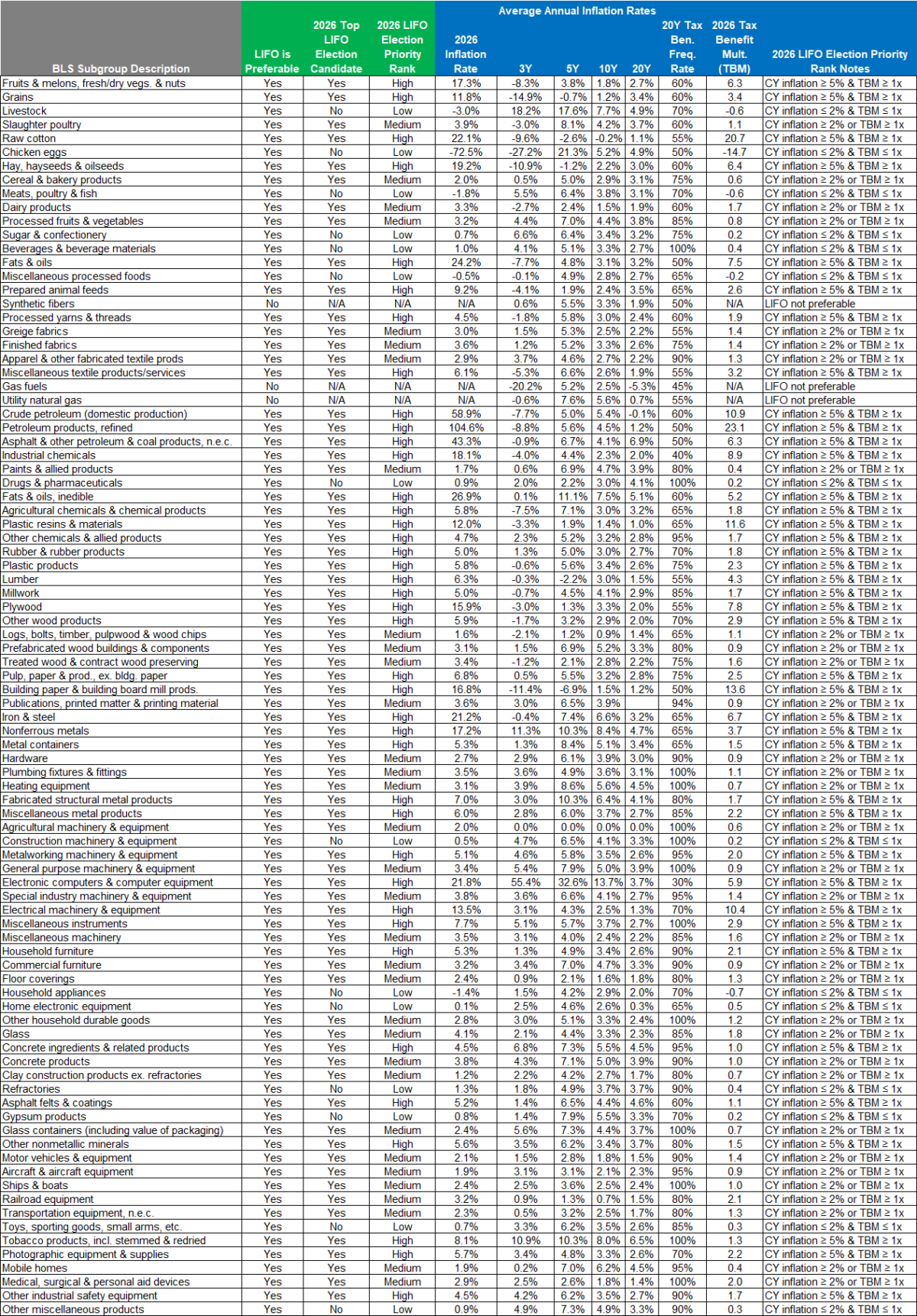
    Table 3. 2026 Top LIFO Candidates by BLS PPI Product Class/Subclass
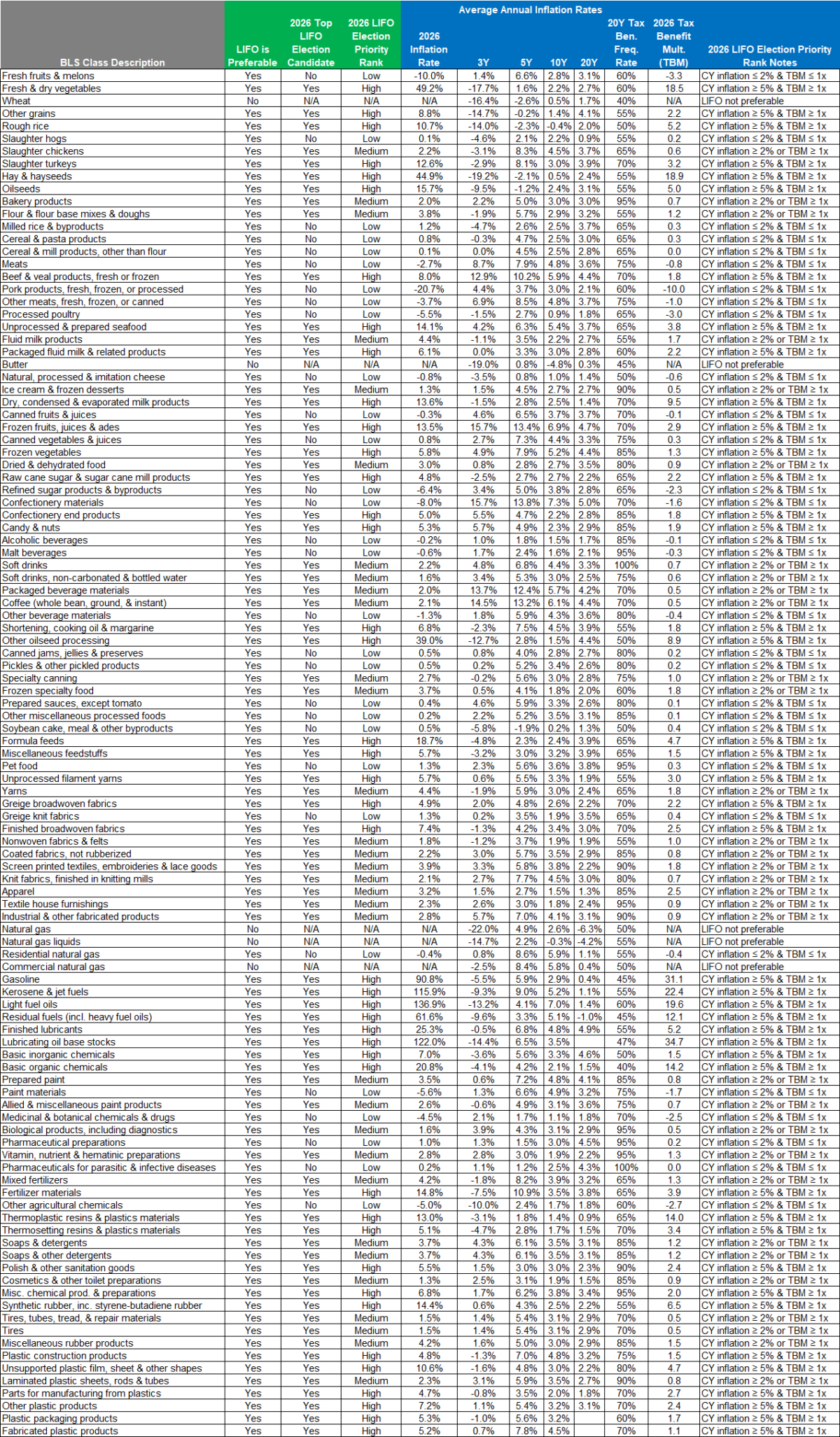
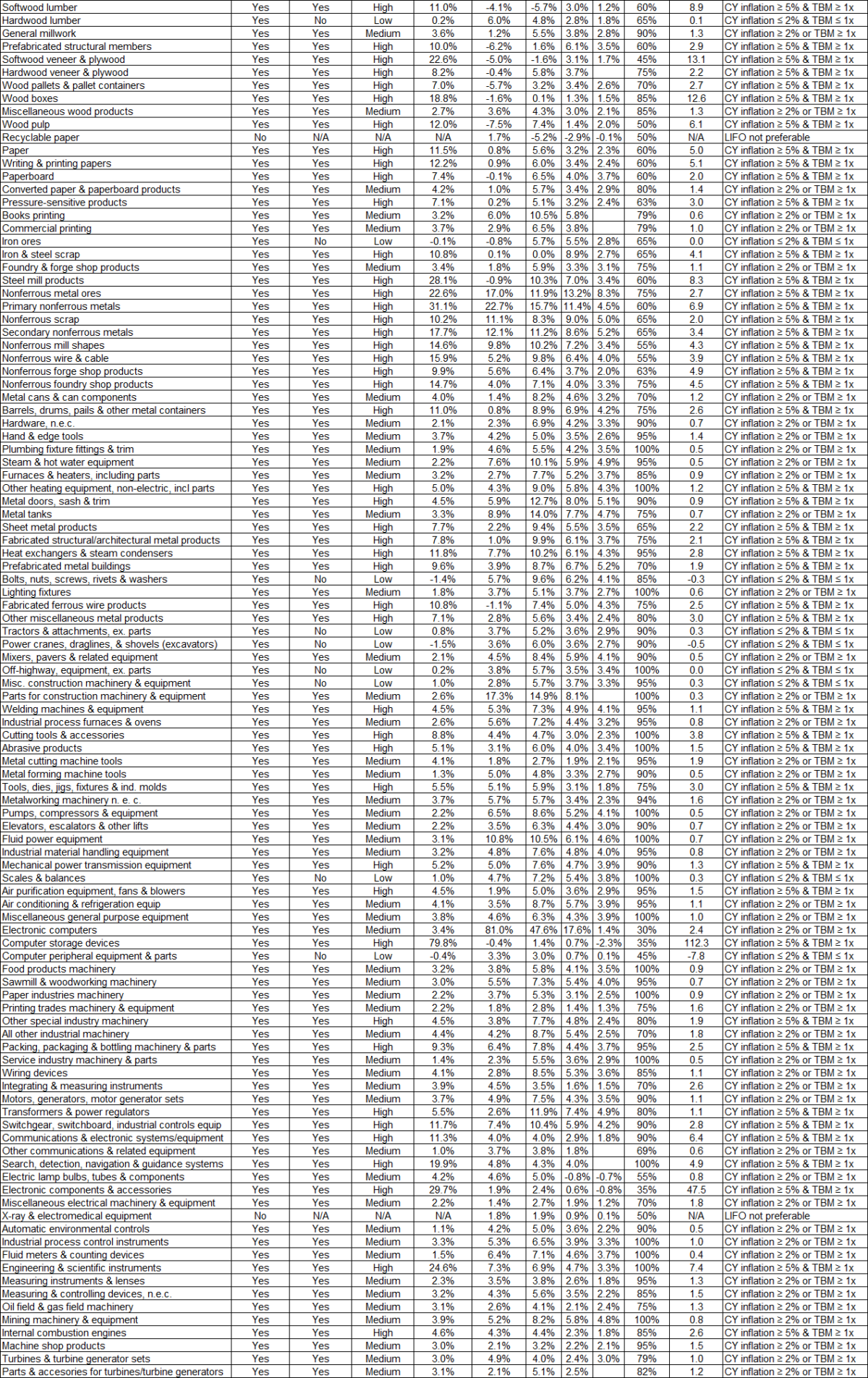
  • Using LIFOPro’s Top LIFO Election Candidates List to Simplify Year End Tax Planning

    The primary purpose of this guide is to offer complimentary resources that empower accounting firms to quickly pre-screen clients who’d potentially benefit from electing LIFO, easily estimate their client’s election year LIFO tax benefits, and simplify the process of integrating LIFO election scoping into their annual year end tax planning. In addition to the resources provided in this guide, LIFOPro assists many accounting firms who are currently or are seeking to scale LIFO planning on a firm-wide basis by providing complimentary, customized high level LIFO election benefit analysis for all potential client/prospective clients.

    Provided below are instructions on how to use LIFOPro’s top LIFO election candidates tables and resources to quickly perform LIFO “pre-screening” on clients or prospects, and easily perform a high-level LIFO election benefit analysis. Separate instructions are provided for accounting firms who’re seeking to perform LIFO election scoping for a single client or small number of clients, and those who’re seeking to prepare a firm-wide LIFO election scoping list.

  • Single Client LIFO Election Scoping
    • Step 1:
      • Go to Pages 9 – 13, locate a single BLS group/subgroup/product class that most closely matches your company/client’s product mix or industry & proceed to Step 3
      • If multiple BLS PPIs were identified that matches your company/client’s product mix/industry, proceed to step 2
    • Step 2: If multiple PPIs match your company’s or client’s industry or product mix, take one the following steps:
      • Use one of the less-detailed BLS tables – For example, if multiple product classes were found that include a portion of but not all of your company or client’s product mix or industry (but no product class was found that included 100% of your goods), review the subgroup table to determine if there is a single subgroup that contains all goods & excludes most or all goods not carried. If no such subgroup can be found, review the major commodity group table and perform the same steps.
      • Use the most predominant group/subgroup/product class in your company/client’s industry or product mix – For example, if your product mix includes 70% of one product class, 20% of another product class & 10% of third product class, select the product class that represents the largest proportion of the total inventory balance.
    • Step 3: Locate the LIFO preferability field entry for the selected PPI & take the following steps:
      • If the LIFO preferability entry is “Yes” – Your company is a goods LIFO candidate. Proceed to Step 4 and/or contact LIFOPro to obtain a free LIFO election benefit analysis.
      • If the LIFO preferability entry is “No” – Your client or company is not a LIFO preferability & LIFOPro recommends not using LIFO (or contact LIFOPro to obtain confirmation of this)
    • Step 4: Locate the Top 2026 Election Candidate field entry for the selected PPI & take the following steps:
      • If the Top 2026 Election Candidate entry is “Yes” – LIFOPro recommends exploring a 2026 LIFO election and obtaining a complimentary benefit analysis from LIFOPro ASAP. Proceed to Step 5.
      • If the Top 2026 Election Candidate entry is “No” – Although your company/client is a LIFO preferability, it is likely that current year LIFO election should be deferred to a future period in time. Consider obtaining a free election benefit analysis from LIFOPro this year, or defer doing so until next year.
    • Step 5: Take any of the following steps to further explore electing LIFO:
      • Estimate 2026 LIFO tax benefit:
        • 2026 taxable income reduction from LIFO (2026 LIFO expense/reserve): Multiply the higher of the two inflation rates shown in the 2026 inflation rate fields by last year’s inventory balance
        • 2026 LIFO tax benefit (2026 LIFO after-tax savings): Multiply the 2026 LIFO expense by your combined federal & state tax rate
      • Contact your client & inform them of the following:
        • High likelihood that LIFO will create meaningful tax benefit for the upcoming year end
        • They can attend a free LIFO discovery call to learn more about LIFO, how to get a free benefit analysis & learn about our turnkey outsourcing solutions which makes being on LIFO as simple as possible
        • They can obtain a free, comprehensive benefit analysis to obtain a more accurate estimate and essential information on how LIFO works, election requirements and method alternatives
      • Schedule a free LIFO discovery call to learn more about LIFO, how to obtain a free election benefit analysis & LIFOPro’s outsourcing solutions:
  • Multi Client LIFO Election Scoping
    • Step 1: Build LIFO election target client/prospect list
      • Export client/prospect list to Excel file
      • Remove client/prospects without inventory or who are already on LIFO from client/prospect list (optional)
      • Add the following available columns/fields to client/prospect list:
        • Industry type description (or primary trade/business description i.e., PBA)
        • Prior year end inventory balance
        • Combined federal + state tax rate (optional)
      • Use available resources to locate & fill the industry type and prior year end inventory balance fields into the client/prospect list (these two fields will allow you to calculate the estimated 2026 taxable income reduction from electing LIFO; combined tax rate will allow you to calculate after-tax cash savings from electing LIFO this year)
      • Download/open LIFOPro’s Good 2026 LIFO Election Candidates Excel file here: LIFOPro’s 2026 Top LIFO Election Candidates List & Tax Benefit Calculator Tool
      • Open LIFOPro file listed above and navigate to the Election Candidate ID Tool Comm Excel sheet
      • Copy/paste the following available fields from client/prospect list Excel sheet to LIFOPro’s Election Candidate Target List Excel sheet:
        • Client name
        • Industry type description
        • Prior year end inventory balance
        • Combined federal + state tax rate
      • Copy/move Election Multi-Company Candidate ID Tool Excel sheet from LIFOPro’s Top LIFO Election Candidate List Excel file to your client/prospect list Excel file
    • Step 2: Identify good 2026 LIFO election candidates using Top 2026 Candidates Commodity Excel sheet
      • Navigate to the 2026 Top Election Candidates Excel sheet of LIFOPro’s Top LIFO Election Candidate Excel file on one screen, and have the Multi-Company Candidate ID Tool Excel sheet open on another screen (or split your screen to view both sheets at the same time if you only have one screen available)
      • In the Multi-Company Candidate ID Tool Excel sheet, locate each client’s Column B Industry Type description & determine if it resembles or matches any of the BLS PPI descriptions shown in Column C of the 2026 Top Election Candidates Excel sheet
      • Take the following steps to fill in the PPI code field located in Column E of the Multi-Company Candidate ID Tool Excel sheet:
        • If a single BLS commodity represents most or all of your client’s product mix: Enter the matching PPI code from Column B of the 2026 Top Election Candidates Excel sheet to your client’s corresponding Column E PPI code row in the Multi-Company Candidate ID Tool Excel sheet
        • If multiple BLS commodities/categories in the list are included in your client’s product mix:
          • Use one of the less-detailed BLS tables – For example, if multiple product classes were found that include a portion of but not all of your company or client’s product mix or industry (but no product class was found that included 100% of your goods), review the subgroup table to determine if there is a single subgroup that contains all goods & excludes most or all goods not carried. If no such subgroup can be found, review the major commodity groups and perform the same steps.
          • Use the most predominant group/subgroup/product class in your company/client’s industry or product mix – For example, if your product mix includes 70% of one product class, 20% of another product class & 10% of third product class, select the product class that represents the largest proportion of the total inventory balance.
    • Step 3: Review, refine & prioritize Election Candidates
      • Review/refine
        • LIFO preferability (Column G): This column indicates your client’s historical inflation metrics met LIFOPro’s criteria for recommending the use of LIFO in general. LIFO elections should only be explored for clients with a Yes value in the LIFO preferability Column, and those with a No value should not use LIFO.
        • 2026 Top Election Candidate (Column H): This column indicates your client is a LIFO preferability, and your client’s current year inflation metrics met LIFOPro’s criteria for recommending a LIFO election for the 2026 year end. LIFO elections should only be explored for clients with a Yes value in the 2026 Top Election Candidate column, and those with a No value should defer exploring a LIFO election to a later period.
      • Prioritize election candidates
        • Assuming you have multiple clients that are top election candidates for the 2026 year end, prioritizing the list ensures your firm’s resources related to client outreach is performed first on the most promising opportunities. Although prioritizing your client list is optional, you can take the following steps to do so by utilizing filters and the metrics shown in the Election Candidate ID Tool Excel sheet:
          • Election year LIFO expense (Column I): Sort from highest to lowest. This will sort the sheet to show the clients with the highest dollar value election year LIFO tax benefits
          • Year to date vs 20Y Average Inflation Multiplier: Sort from highest to lowest. This will sort the sheet to show the clients whose election year inflation is highest in proportion of the historical averages. This is a useful because the higher the multiplier, the more likely it is that this opportunity represents many years worth of tax LIFO benefits.
          • Inflation Frequency Rate: Sort from highest to lowest. This will sort the sheet to show the clients with the most consistently or frequently occurring inflation. For example, the 02 Processed foods and feeds PPI has an 85% inflation frequency over the last 20 years. This means that between 2004 – 2026, there was inflation 17 of the past 20 years & deflation in only 3 of the 20 years.
    • Step 4: Perform client outreach
      • Clients who’ve been identified as a top 2026 year end election candidate should be advised about LIFO by their CPA firms. This can be done simply by informing them of a tax deferral/strategy from electing LIFO, but it can include sharing with them the estimated taxable income reduction or tax savings calculated in the Election Candidate ID Tool.
      • LIFOPro also recommends your firm perform any of the following additional client outreach steps:
        • Advise your client to learn more about LIFO by attending a free LIFO discovery call with LIFOPro OR through your firm
        • Suggest your client obtains a free LIFO election benefit analysis & fee quote from LIFOPro

Section 2: LIFO Election Benefit Analysis

Section 3: Turnkey Outsourcing Solutions

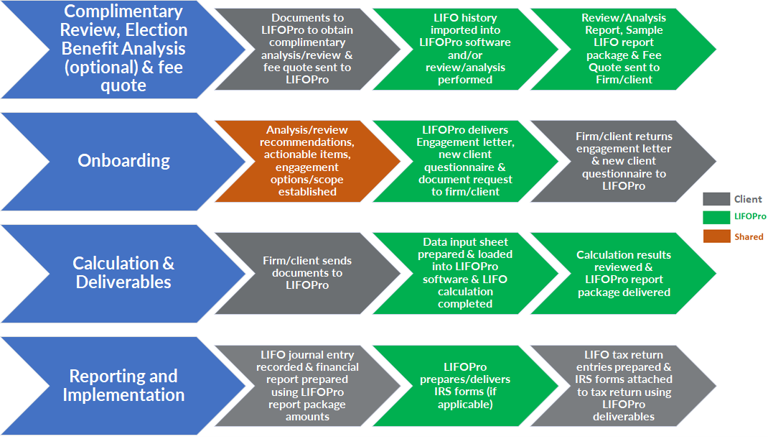
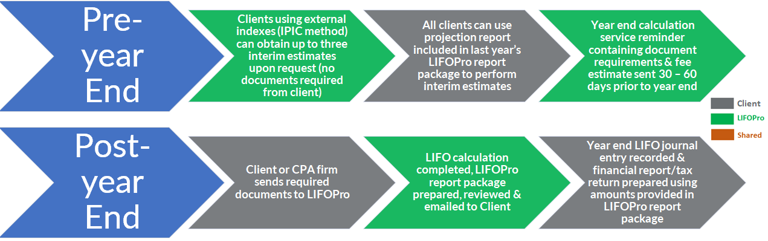
  • Overview: LIFOPro Outsourcing Engagement

    LIFOPro makes being on LIFO as simple as possible. We act as a third party LIFO service provider & subject matter expert to both CPA firms & companies. We design customized solutions that fit your firm & client’s LIFO needs, not a one-size fits all solution that offers more or less than what is needed. Our powerful in-house developed/maintained software allows us to automate most aspects of the work, spend a fraction of the time required by anyone else making manual LIFO calculations & deliver high-quality solutions at the most reasonable costs. Learn more by clicking this link: LIFOPro’s Outsourcing Solutions

    LIFOPro’s Responsibilities

    • Preparing all aspects of the LIFO calculation & supporting documentation free of errors and in accordance with IRS Regs., including
      • Inflation calculation (including BLS category assignments for companies using the IPIC method)
      • Layer calculations
      • LIFO inventory value, LIFO reserve & LIFO reserve change calculations
    • Prepare documentation (LIFOPro reports) that provide adequate books & records of the LIFO inventory value & all supporting computations
    • Deliver LIFOPro report package that includes all amounts required for the client to complete the following:
      • Record this year’s LIFO journal entry which will adjust the year end inventory balance to its LIFO value
      • Prepare the year end annual financial report/statement on a LIFO basis
      • Prepare year end tax return on a LIFO basis
      • Net inventory method adjustments (if applicable; for auto dealers using net inventory method)
    • Interim LIFO estimate preparation & delivery (if applicable)
    • Preparing the book vs. tax LIFO Schedule M tax return entry value (if applicable)
    • Preparing the §263A UNICAP cost Schedule M entry value (if appl. using client-provided absorption ratio)
    • Preparing IRS forms & statements related to LIFO elections or accounting method changes (if applicable)
    • Up to 40 hours of audit support related to the services provided by LIFOPro

    CPA Firm or Client Responsibilities

    • Prepare & furnish the documents required by LIFOPro to complete our services
    • Review LIFOPro report package and confirm all applicable amounts match the client’s books and records
    • Record the annual LIFO adjusting journal entry
    • Prepare the tax return on a LIFO basis
    • Prepare annual financial reports/statements on a LIFO basis
    • Notify LIFOPro of any LIFOPro report discrepancies discovered by the client or notify LIFOPro of adjustments made after LIFOPro report delivery that would affect the accuracy of the client’s LIFO inventory value (if applicable)
    • Attach IRS forms & statements related to LIFO elections or LIFO accounting method changes to the tax return (if applicable)


  • LIFOPro’s Outsourcing Engagement Process Flow: First Year

  • LIFOPro’s Outsourcing Engagement Process Flow: Recurring Annual Outsourcing Engagements

Section 4: LIFO Election Basics & Best Practices

  • Why Use LIFO?

    The LIFO method (last-in, first-out) is the most beneficial inventory-based tax savings strategy because it uses inflation to create material long-term benefits (LIFO creates a tax benefit when there’s inflation), and tens of thousands of companies use LIFO because of this (most companies use LIFO in perpetuity after an election is made since the tax benefits become bigger every subsequent inflationary period). Since the LIFO tax benefit amount is primarily tied to the amount of inflation measured in a given period (for example, a 5x bigger LIFO tax benefit will occur in a period with 10% vs. 2% inflation), thousands of companies have elected LIFO because of the unprecedented inflation that’s occurred over the last few years. When there’s inflation, LIFO creates a tax benefit by lowering the inventory value and increasing cost of goods sold, which in turn reduces taxable income.


  • Quick LIFO Tax Benefit Formula

    Current year LIFO expense (current year taxable income reduction from LIFO): Prior year end inventory balance * Current year end or current period inflation rate

    Current year LIFO tax benefit (current year after-tax savings from LIFO): Current year LIFO expense * Current year combined federal and state marginal tax rate


    LIFO Tax Benefit Example

    • Inputs
      • Prior year end inventory balance: $5M
      • Current period inflation rate: 10%
      • Current year combined federal & state marginal tax rate: 40%
    • Outputs
      • Estimated current year LIFO expense: $5M * 10% = $500K
      • Estimated current year LIFO tax benefit: $500K * 40% = $200K
  • Does the Timing of the LIFO Election Matter?

    Although LIFO can create meaningful short and long term tax benefits, there are many considerations that should be made prior to and during the implementation process. Most importantly, the timing of adopting LIFO is key for the following reasons:

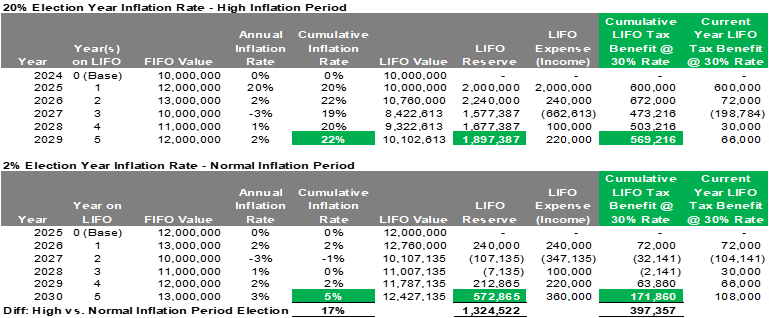
    • For tax purposes, LIFO must be applied prospectively (beginning in year LIFO is adopted), and the tax benefits are directly tied to the amount of inflation measured in the year of adoption (high inflation that recently occurred in a prior period can’t be applied in the LIFO election period)
    • The size of the first year tax benefit is primarily dependent on the amount of inflation measured in LIFO election year, making above-average inflation periods the most favorable time to elect LIFO (see comparison below)

    LIFO Election Timing Comparison Example
  • Does the Chosen Inventory Valuation Method Need to Match the Physical Flow of Goods?

    The actual flow or physical movement of goods does not need to match the inventory costing method used to value inventory (aka cost flow assumption). The most two most predominant inventory valuation methods can be simplified as follows:

    • LIFO:
      • Matches current costs with current revenues, reducing income & providing a better measure of current earnings
      • Commonly called the income statement approach as it provides the clearest reflection of income & costs of goods sold (removes inflation component from income)
    • FIFO (first-in, first out):
      • Ending inventory most closely matches the current costs since it consists of most recent purchases
      • Commonly called the balance sheet approach because it most closely matches physical flow of goods
      • Charges oldest costs against more current revenue, and creates artificial inventory profits
  • Are Unit Costs Required to be Tracked on a LIFO Basis Subsequent to Adoption?

    Because of the advantages of the dollar-value method & disadvantages of the unit LIFO method, almost all companies using LIFO track and value inventories in their accounting system on a FIFO, average cost or standard cost basis for the following reasons:

    • They use the dollar-value method which requires for unit costs to be tracked and valued on a non-LIFO basis
    • Most accounting systems are designed to track and value inventories using FIFO, average cost or standard cost
    • Companies often base their pricing decisions on a FIFO, average cost or standard cost assumption
    • Recordkeeping on a non-LIFO basis is easier since LIFO does usually not approximate the physical flow of goods
    • Profit-sharing & other bonus arrangements often depend on a non-LIFO cost flow assumption

    One of the biggest misconceptions is item/unit costs must be tracked and valued on a last-in, first out basis once LIFO is adopted. Although this is not true, it’s a misnomer that causes many companies to not to use LIFO. The reality is there are two methods or options how goods are to be tracked and valued on a LIFO basis, which are as follows:

    • Dollar-value method: The dollar-value method measures inflation in terms of the total dollar value of the inventories at a FIFO, average cost or standard cost basis, not by the physical quantity & unit cost on a LIFO basis. Under this method, inventories continue being tracked and valued on a non-LIFO basis in perpetuity even incident & subsequent to adopting LIFO. When the dollar-value method is used, a top-side adjustment is recorded to account for the difference between the inventory value at cost (FIFO, average cost etc.) & the LIFO inventory value. When using the dollar-value LIFO method, item/unit costs are never “LIFO-ized”. What instead occurs is that goods continue to be tracked and valued under a company’s existing method, and at the end of the year, an inventory report showing the quantities and item/unit costs on a non-LIFO basis is generated and exported out of the accounting system in order to calculate inflation & perform the total LIFO inventory value. Once this occurs, inflation is calculated outside of the accounting system, layer at base year cost and LIFO cost are determined, the total LIFO inventory value is determined, the change between the current & prior period’s LIFO reserve is computed, and a top-side journal entry is recorded to adjust cost of goods sold and LIFO reserve (many companies outsource this work to LIFOPro or license our software to automate their in-house dollar-value LIFO calculation).
    • Specific goods method (aka unit LIFO): The unit LIFO method is most often illustrated in tutorials and taught in college accounting courses because the underlying concept is simpler to illustrate than the dollar-value LIFO method. In reality, integrating the unit LIFO method in a perpetual accounting information system is extremely burdensome & sometimes to costly to implement. Under this method, item costs are tracked on a LIFO basis, and the accounting system must be set up in a manner to assume a last-in, first out basis cost flow assumption, meaning the sales of goods must be set up in a manner where the newest goods are sold first and the oldest items remain in stock. Said another way, each item’s unit cost must be LIFO-ized & the total inventory value on a LIFO basis is determined by taking the sum of the extended LIFO cost of all items. Under this method, companies often maintain two separate cost flow assumptions within their accounting information system: 1. Costing method used in the existing accounting system 2. unit LIFO method. One additional shortfall of the unit LIFO method is that it creates a materially lower tax benefit over a long period of time when compared to the dollar-value LIFO method. This is due to the fact that when new items enter into inventory and other items are no longer stocked (due to being discontinued or new items replacing them), the LIFO reserve associated with the items no longer stocked is recaptured under the unit LIFO method.

    Simply put, the dollar-value method avoids LIFO’s most undesirable characteristics by allowing companies to maintain their existing accounting systems on a non-LIFO basis, and only requiring for a top-side journal entry to be made annually. Because of this, the vast majority of companies on LIFO use the dollar-value method. Because of this, very few companies use the unit LIFO method.

  • Common LIFO Misconceptions
    • Misconception #1: The following burdens & costs outweigh the benefits of LIFO:
      • Wholesale changes must be made to accounting system since item costs & the physical flow of goods must be tracked on a LIFO basis
      • Complicates management, cost accounting & purchasing/sales functions & responsibilities
      • Clarifications
        • When the dollar-value method is used, the LIFO value of inventory is determined outside of the accounting system & a top-side accounting entry is recorded to adjust ending inventory from cost to LIFO & accrue the change in the LIFO reserve
        • When the dollar-value method is used, internal management and reporting functions are unimpeded by LIFO because unit costs must continue being tracked at cost (as opposed to the specific goods or unit LIFO method which tracks unit costs on a LIFO basis)
    • Misconception #2: Employee compensation & bonuses will be complicated from using LIFO
      • Clarification: Internal management reports can be presented on a non-LIFO basis as long as they’re only being used internally
    • Misconception #3: LIFO tax benefits will be minimal because of high inventory turnover or new item rates
      • Clarifications
        • Under the dollar-value method, the inflation rate used to calculate the LIFO reserve change is based on a 12 month comparison of current vs. prior year’s item/unit costs extended by quantities on hand in ending inventory regardless of the turnover ratio
        • External indexes reconstruct inflation on new items, which ensures the same amount of inflation is applied to new & preexisting items
    • Misconception #4: Internal costs must be used to measure LIFO inflation
      • Clarification: External indexes such as the BLS CPI/PPI can be used to measure inflation, thereby minimizing reliance on accounting information systems
    • Misconception #5: LIFO reserve change misconceptions:
      • This year’s LIFO reserve can’t grow unless this year’s ending inventory balance is as much or higher than last year’s ending inventory balance
      • This year’s LIFO reserve will decrease if this vs. last year’s inventory balance decreases
      • Clarifications
        • In most cases, material LIFO recapture only occurs when there is either substantial deflation and/or substantial inventory liquidations
        • When there’s inflation, LIFO reserve can increase even when current vs. prior year inventory balances decrease
        • Any LIFO recapture (LIFO income) caused by inventory decreases can be partially or fully offset by the LIFO expense created from inflation
  • LIFO Election Requirements, Considerations & Disclaimers

    IRS LIFO Requirements

    • IRS Annual LIFO Calculation Requirement & LIFO Conformity Rule (See IRS Regs. §472(c), §472-2(e) & §472-2(g)
      • Taxpayers are required to annually calculate the ending LIFO inventory value beginning in the year that LIFO is adopted for tax purposes, and all subsequent periods that the LIFO method is used
      • The IRS LIFO conformity rule requires taxpayers to present income on year end financial report/statements as determined under the LIFO method beginning with the first year that LIFO is used on the tax return (also applies for all subsequent year end financial reports/statements where the LIFO method is used for tax purposes)
      • A LIFO adjusting journal entry must be made annually following the close of the year end, completion of the LIFO calculation & prior to preparing year end financial reports/statements to comply with the LIFO conformity rule
    • IRS LIFO Books & Records Requirement (See IRS Regs. §472-2(h))
      • A taxpayer’s current LIFO value inventory is a historic accumulation of quantity & price changes from the taxpayer’s initial year of the LIFO election
      • Therefore, the taxpayer must maintain supplemental & detailed LIFO inventory records that support the current value of the inventory & the clear reflection of income
    • IRS Reserves & Write-downs Requirement (See IRS Regs. §472(d) & §472-2(b)
      • For tax purposes, LIFO inventories must be valued at cost, meaning they must be determined gross of or excluding reserves & write-downs beginning in year of election & all subsequent periods inventories are valued using LIFO
      • For tax purposes, all preexisting non-LIFO reserves or write-downs must be recaptured into income ratably over a 3-year period beginning with year that LIFO is adopted for tax purposes
      • Examples of reserves or write-downs include Lower of cost or market reserves (LCM), obsolete/slow-moving reserves (OSMI) or arbitrary write-downs other than shrink or trade discounts/vendor allowances (and net inventory method adjustments required for auto dealers)
      • For financial reporting purposes, LIFO inventories can be valued at the lower of cost or market and can include or be net of any inventory-related reserve or write-down
      • Financial reporting non-LIFO inventory reserves or write-downs must be accounted for on the tax return via a Schedule M adjustment since the tax Current-year cost must exclude or be gross of reserves/write-downs
    • The IRS may terminate a taxpayer’s LIFO election if the taxpayer fails to comply with any of the three requirements listed above. See Rev. Proc. 79-23, Sec. 3.01.


    Disclaimers

    • Portions or all of LIFO reserve may be taken back into income if the following occurs:
      • Portion of LIFO reserve may be taken back into income in periods where one or both of the following occurs (also known as LIFO recapture):
        • Deflation
        • Material inventory liquidations (for example, a 50% decrease in the CY vs. PY inventory balance)
      • All of LIFO reserve will be taken back into income when either of the following occurs:
        • C to S Corp conversions
        • Business asset sales
      • Terminating LIFO:
        • LIFO reserve must be ratably recaptured into income over a 4 year period beginning in termination year
        • Automatic approval to terminate LIFO election at any point in time
        • IRS Form 3115 must be filed to switch from LIFO to a non-LIFO method


    Other Considerations

    • LIFO should only be elected for tax purposes when there’s inflation
      • Electing LIFO when there’s deflation will increase taxable income, meaning it’s best to wait until there’s inflation to elect LIFO
      • Some companies may employ a strategy to elect LIFO for book purposes but not tax purposes if there’s deflation as it’ll create a favorable impact to income on the financial statement & a permanent favorable book vs. tax difference
    • Many companies wait until they’re profitable to elect LIFO
      • Tax benefits of LIFO far outweigh the cost when there’s sufficient income to offset
      • Additional losses from LIFO can be carried forward and back, but the perceived tax benefit of LIFO is often less when a company is not profitable
  • LIFO Financial Reporting Disclosure Requirements & Alternatives

    IRS Regs. §1.472-2(e) requires income to be reported and inventories to be valued on a LIFO basis on the face of the income statement and balance sheet beginning in the same year that LIFO is adopted for tax purposes. This is commonly referred to as the LIFO conformity rule. An overview of the LIFO financial reporting disclosure rules and alternatives are listed below.

    • LIFO Disclosures
      • Face of the annual or year end income statement must present income, profit or loss using the LIFO method beginning no later than the year that LIFO is adopted for tax purposes
      • Once LIFO has been elected for tax purposes, income, profit or loss must be computed using LIFO on the face of all subsequent annual financial statements (unless LIFO is terminated for tax purposes)
    • Non-LIFO Disclosures: The following non-LIFO disclosures and information are allowed within financial statements while also maintaining LIFO conformity compliance (see IRS Regs. §1.472-2(e)):
      • Supplemental and explanatory information using a non-LIFO method – Includes anything other than the primary presentation of the income statement, which includes the following:
        • Notes to the income statement
        • Appendices & supplements to the income statement
      • Other reports included in the financial reports, such as:
        • Management’s discussion and analysis
        • Statement of changes in financial position
        • Letters to shareholders, partners or other stakeholders
        • Summary of key figures
      • Inventory asset value disclosures
    • Internal Management & Interim Reports
      • Internal Management Reports – The use of a non-LIFO method is allowed on all portions of internal management reports as long as the reports will not be issued or released to parties outside of the organization. Examples include earnings projections, budgets, and sales forecasts.
      • Interim reports – If issued in accordance with GAAP, same LIFO disclosure rules described above apply. If not issued in accordance with GAAP, then interim reports are not required to be presented on a LIFO basis (exception – series of interim reports that can be used to ascertain income, profit & loss by combining those reports)
  • Interim LIFO Estimate Best Practices

    Companies perform interim LIFO estimates for a wide array of reasons, including:

    • Financial reporting compliance – Under Generally Accepted Accounting Principles, an estimate for the interim cost of sales is required for interim reporting purposes. Because of this, companies issuing interim GAAP financial statements often include an estimated LIFO adjustment in their interim reports.
    • Tax – Although tax law defines LIFO as an annual calculation, many companies perform interim estimates into their quarterly estimated tax payments
    • Forecasting and planning – Many companies perform at least one interim LIFO estimate in order to properly forecast and plan the estimated LIFO effect on their bottom line. An added benefit of doing so is to smooth out the effect of the estimated LIFO reserve change over the course of the year as opposed to booking a single LIFO adjustment at year end. An added benefit of forecasting & planning is that one can avoid material or unexpected surprises from LIFO at year end.
    • Maximize the LIFO reserve increase (or minimize the decrease) –When there’s inflation, a minimum  balance is required to avoid what is known as layer erosion effect LIFO income (aka LIFO recapture or income). If the Current-year cost is below the minimum required amount, LIFO recapture will reduce the LIFO tax benefit created by inflation for that period (or in some cases, a net LIFO reserve decrease can occur from substantial layer erosion income). Because of this, some companies will plan their year end purchases to achieve the most desirable LIFO results to minimize the effects of layer-erosion LIFO income.

    Companies that don’t issue interim financial reports are not required to perform interim LIFO estimates.

    Companies that issue non-GAAP interim reports are also not required to perform interim LIFO estimates.

  • LIFO Election Scope: Why the Goods Valued Using LIFO is Not All or Nothing

    Some or all goods can be valued using LIFO. A selective election scope infers that less than 100% of inventories are valued using the LIFO method. Although a general rule of thumb is to place all goods on LIFO to maximize the tax benefit, thorough analysis is highly recommended prior to electing LIFO. This is because including deflationary goods in the election scope could materially reduce LIFO’s long-term tax benefits. LIFOPro’s best practices regarding determining the LIFO election scope is described below.

    • Perform analysis prior to election to determine if some or all goods have historically been inflationary: Prior to electing LIFO, thorough analysis should be performed where historical pro forma LIFO calculations are made to measure past inflation levels, inflation frequency and the resulting LIFO tax benefits. If there is a diverse product mix or material amounts of goods with differing cost characteristics, further analysis should be performed at a more granular level to determine the historical inflation by group or product type. If all goods have historically been inflationary, the long-term strategy should be to value 100% of the goods using LIFO, but if any material portion of goods have a history of deflation, the short & long-term strategy should be to exclude the deflationary goods from the LIFO election scope.
    • Year of LIFO election: When there is a diverse product mix, additional analysis should be performed to determine if all goods have inflation in the year of the LIFO election, or if there are any material portions of goods with deflation. If there is significant deflation in a material portion of goods in the LIFO election year, a best practice is to make a selective LIFO election for the inflationary goods to prevent the deflationary goods from reducing the election year LIFO tax benefit.
    • Year proceeding LIFO election: If goods were excluded from the LIFO election scope in the year of adoption but have an inflationary history, a best practice is to expand the election scope to include those goods in the first subsequent period where there is sufficient inflation & LIFO tax benefit to merit doing so (IRS Form 970 must be filed; change is applied prospectively beginning in year of change).
    • The following are other examples of why certain goods may be excluded from the LIFO election scope
      • Existing entity using LIFO acquires a business not using LIFO & chooses to keep them off LIFO because the additional tax benefits would be minimal
      • Tax benefits of including certain inventories in the election scope is less than the cost and administrative burden
  • Establishing LIFO as a Preferable Method

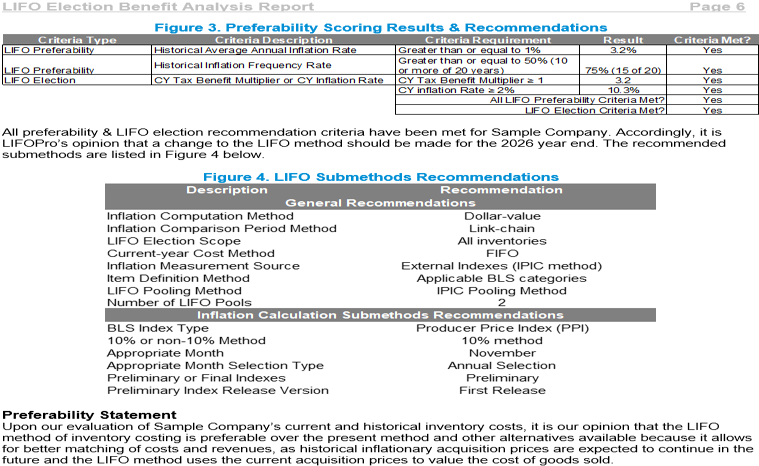
    The costing method used to value inventory is considered an accounting method or principle. Since there are multiple inventory valuation methods available, preferability must be established when changing to the LIFO method from a non-LIFO method. Because of this, companies issuing GAAP financial statements must establish that LIFO is preferable to the existing method. LIFOPro’s benefit analysis reports use our proprietary key performance indicators to measure if LIFO is or is not a preferable method. Included within our complimentary benefit analysis report is a preferability statement customized for your client or prospective client, which can be used in their year end financial statement in the year of adoption.

    In addition to our benefit analysis report’s key performance indicators, LIFOPro has access to the following materials that can be used to assist with justifying the preferability of the LIFO method, including:

    • Reference of publicly-traded companies on LIFO that are in a similar industry as your client
    • Reference of privately held companies on LIFO that are LIFOPro clients
    • Reference of companies on LIFO who’re mutual clients of LIFOPro and your accounting firm


    Contact LIFOPro today to learn how we can assist with justifying LIFO as a preferable method for your client!

    Schedule a Call or Meeting with LIFOPro

    How LIFO Works & LIFOPro’s Offerings

Resources

2026 LIFO Election Opportunities Guide
Read more
Comparing LIFO Tax Benefits to Lower of Cost or Market Write-downs
Read more
LIFO Election

Let LIFOPro help maximize your LIFO benefit and minimize the administrative burden of being on LIFO. Get a free LIFO benefit analysis to determine the proper methods, sub-methods, timing for a potential LIFO election for your company.

Read more
Best LIFO Practices

Your comprehensive resource for best LIFO practices, LIFO election requirements, and LIFO calculation approach alternatives!

Read more
If the IPIC method is good enough for the IRS, it should be good enough for GAAP
Read more
Using Bargain Inventory Purchases to Create Sizable LIFO Election Tax Benefits
Read more
Use of External Inflation Indexes for Financial Reporting
Read more
Financial Reporting & Tax Treatment of Change to LIFO Method
Read more
CPA Firm Partnership Playbook
Read more
Sec. 473 Relief Estimate Request Form
Read more
Auto Dealer IPIC LIFO Case Study
Read more
How LIFO Works: A Beginner’s Guide to LIFO
Read more
How to Identify Clients that are Good LIFO Election Candidates
Read more
Complimentary Interim LIFO Estimate Request Form
Read more
Best LIFO Practices & Review
Read more
Auto Dealer LIFO Case Study
Read more
LIFO Election Benefit Analysis
Read more
Downloads

Get information about LIFO-PRO’s offerings, valuable guides & white papers & sample LIFO reports!

Read more
IPIC LIFO Guide

Get educated on the Inventory Price Index Computation (IPIC) method, including the origins, advantages & disadvantages, calculation procedures, options & much more!

Read more
Service Organization Control Report

Learn how LIFO-PRO receives an annual review of our policies & procedures to provide required assurances to our clients.

Read more
LIFO Tax Benefit Calculator

Calculate the potential tax savings from using LIFO & determine your company’s historical inflation percentages!

Read more
Secure File Upload Portal

Here you can send us all files needed for us to seamlessly give you the best LIFO results possible. We look forward to working with you!

Read more
CPA Firm LIFO Opportunities & Training Guide

Learn about LIFO opportunities abound for CPA firms, how to increase the scope of your LIFO offerings & learn how to easily identify good LIFO candidates!

Read more
Interim Estimate Options

Learn how to obtain interim LIFO estimates within our software or LIFO outsourcing solutions!

Read more
Non-disclosure Agreement Request Form

Get a NDA generated electronically in less than a minute using LIFO-PRO’s online request form page & avoid having to print, sign & scan a paper NDA!

Read more
IPIC LIFO Resources

Learn how the IPIC LIFO Method works, find valuable Bureau of Labor Statistics (BLS) links and stay up to date on all changes related to the IPIC Method!

Read more
LIFO Success Stories

Learn about LIFOPro’s past roles in partnering with companies & CPA firms to deliver great value by finding solutions to the most challenging LIFO issues!

Read more
IPIC LIFO Overview

The Inventory Price Index Computation (IPIC) method allows taxpayers to use published external indexes to calculate inflation for the purpose of valuing LIFO inventories.

Read more
LIFO Authoritative Guidance

Your comprehensive resource for authoritative LIFO guidance, LIFO election requirements, and method alternatives!

Read more
Supermarket Physical Count Procedures

Find helpful information on how IRS regulations effect grocery LIFO Count Procedures for CPI & PPI taxpayers on our Supermarket Count Procedures page.

Read more
Special Challenges for Supermarkets

Supermarkets face LIFO calculation issues unique to the industry. Find out why & answers to how they are dealt with Special Challenges for Supermarkets page.

Read more
Why the Double-extension LIFO Index Calculation Method is Unreliable

Facts describing why the double-extension LIFO index calculation method is unreliable and examples proving how this method creates unpredictable results.

Read more
LIFO Training & Audit Guide

The LIFO Inventory Training Basics & Audit Guide provides detailed LIFO calculation steps, LIFO documentation procedures, internal controls & audit best practices.

Read more
Addition of Services Table 9 Codes

Find recent important changes & BLS addition of Table 9 Wherever-provided Services & Construction PPI Indexes & Important Change in PPI Code Structure page.

Read more
CPI Category Updates

Find information on CPI Category Changes & Bureau of Labor Statistics Consumer Price Index update information such as new medical commodity codes here!

Read more
PPI Category Updates

Learn IRS Regulations Requirements for missing PPI Indexes, procedures for reassigning discontinued PPI Categories at LIFO-PRO’s PPI Category Changes page.

Read more
Producer Price Index Usage by Supermarkets to Increase Tax Deferral

Learn how drugs, non-foods & food/beverage indexes cause increase LIFO tax benefits at our PPI Index Usage by Supermarkets to Increase Tax Deferral page.

Read more
Consumer/Producer Price Index Inflation History

Get the most up to date Bureau of Labor Statistics Consumer & Producer Price Index inflation data from LIFOPro!

Read more
IPIC LIFO Advantages

Switching from the double-extension to link-chain method? Want to achieve higher possible inflation indexes? Learn more at the IPIC LIFO Advantages page.

Read more
LIFO Repeal Updates

Get the latest LIFO repeal updates including the latest news on corporate tax reform at LIFO-PRO’s LIFO Repeal Updates page.

Read more
Videos

LIFO-PRO Company Overview – Quick 1 minute video explaining LIFO-PRO’s service and software offerings.

Read more
Request Forms Page

Request a software trial, LIFO Election Benefit Analysis, Best LIFO Practices Methods Review or cost estimate. All of our requests are complimentary & free of obligation!

Read more
FAQ’s

View some of our frequently asked questions to learn more about LIFO

Read more
LIFO Glossary

Accounting and financial professionals who work with LIFO need to understand the jargon associated with LIFO. Below are a number of LIFO-related terms.

Read more

Subscribe Today

Sign up today to receive industry news & promotional offers from LIFO-PRO